
When AI generates dozens of test cases at once, it is easy to assume that coverage must be adequate. The count says nothing about whether critical risks are covered, and it does not prove that each expected result has a source.
Review each case back to its requirement and risk. Then check whether the steps and assertions can actually reveal a fault.
Start with traceability
Give the confirmed login rules IDs and have each case refer to a relevant rule or risk:
| Rule | Testing focus |
|---|---|
| R-01: Verification codes are valid for five minutes | Within the valid period, after expiry, and the boundary still needs confirmation |
| R-02: Each phone number can request at most 20 codes per day | Behavior at the limit; the counting window still needs confirmation |
| R-03: Five consecutive incorrect attempts trigger a 15-minute lockout | The fifth failure, requests during lockout, and the reset condition |
| R-04: An account is created after the first successful verification | Create it after success; confirm from the requirement whether failure leaves an account or other state |
These are still exercise assumptions from the series. Real cases should cite the project requirement ID, API contract, or decision record. If an expected result has no source, mark it as needing confirmation rather than treating it as product behavior.
Beginner guide: start with one confirmed requirement
You do not need dozens of cases for your first review. Choose one short, clear requirement and work through these steps:
- Find the source. Locate the requirement, acceptance criteria, or API contract. Record its ID and version. Note gaps rather than asking AI to make product decisions.
- Give AI enough context. Provide the requirement, known constraints, test scope, and output format. Ask it to list unknowns as “Needs confirmation.”
- Generate a small set. Ask for representative happy-path, failure, boundary, and state-change scenarios. For each case, include its rule, preconditions, inputs, expected result, and observation point.
- Trace every case. Use the review checklist below to check for omissions, unsupported expectations, weak assertions, and unexecutable steps.
- Verify representative cases. Prepare data and execute them in an authorized test environment. Record the result. An unrun case remains unverified.
- Feed findings into the next round. Record issue types and confirmed decisions. Keep the examples that reproduce the problems, not only the revised cases.
A first prompt could look like this:
Generate only five representative test cases from the requirement below. Do not invent product behavior that is not specified.
Requirement text and version: [provide]
Confirmed rule IDs: [provide]
Test scope and known constraints: [provide]
Use a table with: case ID, source rule, risk, preconditions, input, steps, expected result, and observation point.
Mark missing rules and uncertain expectations as “Needs confirmation,” and say who needs to confirm them.
Common review problems beyond coverage gaps
| Issue | Example | Why it matters |
|---|---|---|
| Coverage gap | No check for an expired code or for the end of a lockout | A critical state may never be tested |
| Unsupported assumption | The case invents an HTTP 400 response or “Incorrect code” message | The actual contract may differ |
| Weak assertion | It checks a successful response but not the account state | A response can look correct while the business outcome is wrong |
| Unexecutable steps | It does not explain how to prepare an expired code or reach the rate limit | Testers cannot reproduce the case reliably |
| False pass | The test is skipped, an exception is swallowed, or an assertion is always true | The result cannot support a quality claim |
Check side effects on failure paths too. After an incorrect code is rejected, did the system still create an account? Checking only for an error message could miss a changed data state.
A practical review checklist
For each case, ask:
- Can the expected result be traced to a requirement, API contract, or confirmed behavior?
- Does the set cover normal and error paths, boundaries, state changes, permissions, and important dependencies?
- Can the preconditions and test data be prepared consistently, and can the steps be repeated?
- Do assertions check the business outcome and relevant data side effects, not just a page or status code?
- Could the test pass because it was skipped, an exception was caught and ignored, an assertion was empty, or the environment happened to behave a certain way?
If an important test passes, ask one more question: would it fail if the target behavior were broken on purpose? A controlled test double or a small mutation can help verify that an assertion is effective. Do not break functionality casually in a shared or production environment.
Example: trace a rule to an assertion
The example below uses the exercise rule R-03, “Five consecutive incorrect attempts trigger a 15-minute lockout.” It shows a review method; it does not describe an actual product rule or test run.
| Review item | What to check | How to interpret the result |
|---|---|---|
| Requirement source | Does the case cite R-03 and its version, rather than adding a rule from experience? | Without a source or version, the expected result needs confirmation |
| Boundary inputs | What happens on failures 1–4, the fifth attempt, and during lockout? | A case that only checks for an error message has not covered the threshold |
| Observation point | Can you inspect authentication or server-side lockout state, rather than only page copy? | A message alone does not confirm the server state changed |
| Timing | When does the 15-minute period start, and how is its end boundary handled? | If the rule does not define inclusivity, record an open question |
| Execution evidence | Record the case ID, environment, test-data identifier, run time, assertion result, and raw report location | An unrun case remains unverified; its design is not a pass |
If an AI-generated case does not distinguish the fourth from the fifth attempt, identify that missing boundary and ask for an expected result with a source. If the rule does not define the response during lockout, list it as a question. Do not invent a status code or message for Product.
To turn a vague description into a reviewable condition, add the source, data, and observation point, then check whether the expected result is actually specified:
| Wording | Review judgment |
|---|---|
| Weak case: “Enter a wrong code repeatedly; the page shows an error.” | It has no rule ID, attempt count, lockout observation, or failure-side-effect check. It cannot show that R-03 was verified. |
| Reviewable case: “Under R-03, use a resettable synthetic phone number in an isolated environment. Submit four consecutive incorrect codes and record the state; reset the counter, then submit five consecutive incorrect codes and observe the state after the fifth. Check responses against the API contract and use an authorized state query to confirm lockout. Record account side effects and cleanup.” | The scenario and observation points are clear. The exact response, test hook, copy, and boundary inclusivity still need the project contract; mark undefined details as “Needs confirmation.” |
This rewrite adds observation steps without deciding product rules. It surfaces behavior that still needs confirmation and checks account side effects; a visible message alone does not prove R-03.
Ask AI to find problems, not to certify its own work
You can use this instruction for a second review of generated cases:
Review the following test cases. Do not add more cases. For each case, check:
- whether it has a requirement source and turns unknown rules into facts;
- whether it misses important states, boundaries, failure paths, or side effects;
- whether its preconditions and steps can be executed consistently;
- whether its assertions can detect the target problem;
- whether the test could still pass when the feature is wrong. Cite the requirement as evidence. Mark anything you cannot confirm as “Needs confirmation.”
This review can share the same blind spots as the model that generated the cases. It is a screening aid, not an independent certification. Higher-risk behavior still needs review by testers, Product, or Engineering, plus execution and evidence from the real test environment.
AI Test Auditor can complement this review with source-only checks for a limited set of patterns in supported JavaScript and TypeScript tests. It does not run tests, inspect runtime behavior, or calculate coverage. An unflagged test remains unassessed rather than proven effective. Check the project documentation to confirm the supported test frameworks and source scope fit your examples.
AI Test Auditor: https://github.com/AI-Native-QA-Lab/ai-test-auditor
Try a small exercise: choose a few existing cases, add their requirement sources, check the boundaries and assertions, and record the types of issues you find. That will show you more about the distance between generated cases and trustworthy tests than doubling the case count.
Best practices: make review findings reusable
- Keep the source for every expected result: a requirement, API contract, or decision record. Mark expectations without a source as needing confirmation.
- Review coverage by risk. Prioritize boundaries, state transitions, permissions, failure paths, and side effects instead of treating case count as coverage.
- Record “designed,” “executed,” and “verified” separately. Not run, skipped, failed, and passed are different states.
- Use a controlled mutation or test double to check whether important assertions can detect a fault. Do this only in a safe, isolated test environment.
- Keep a small regression set of confirmed rules, counterexamples, and review criteria. Recheck it when the rules or generation method changes; do not treat an old result as a permanent guarantee.
Frequently asked questions
Can I use AI-generated test cases as they are?
Do not assume so. Check the source for each expected result, risk coverage, data setup, assertions, and side effects, then execute suitable cases. AI output is a draft for review, not proof of quality.
Where should a beginner start?
Start with one confirmed requirement. Ask AI for a small set of traceable scenarios, review each against the requirement, then execute one representative case. The “Beginner start” steps and prompt above are enough for a first pass.
How can I find scenarios AI missed?
Break requirements into rules and risks, then check happy paths, failures, boundaries, state changes, permissions, and side effects. Coverage gaps may remain when a case cannot be tied to a requirement or risk.
Is a second review by the same AI independent verification?
No. A second pass can screen for obvious issues, but the model can repeat the same blind spots. High-risk scenarios still need review by someone who knows the domain and evidence from test execution.
What if the requirement does not define a response code or error message?
Do not guess. Mark the behavior as needing confirmation and ask the requirement or API owner before writing an expected result. Otherwise, automation can turn an unapproved assumption into a fixed rule.
How do I improve the review over time?
Classify omissions, weak assertions, and unsupported assumptions. Revise the requirement context, generation Prompt, or review rules, then check the same representative samples again. The dedicated quality loop below shows the cycle.
Focus: make case review part of the daily quality loop
The quality loop is not a one-time review or a request for AI to generate more cases. Whenever a story or requirement changes, feed real findings into the next round and use fixed samples to check whether the change reduced omissions instead of merely making the output look more complete.
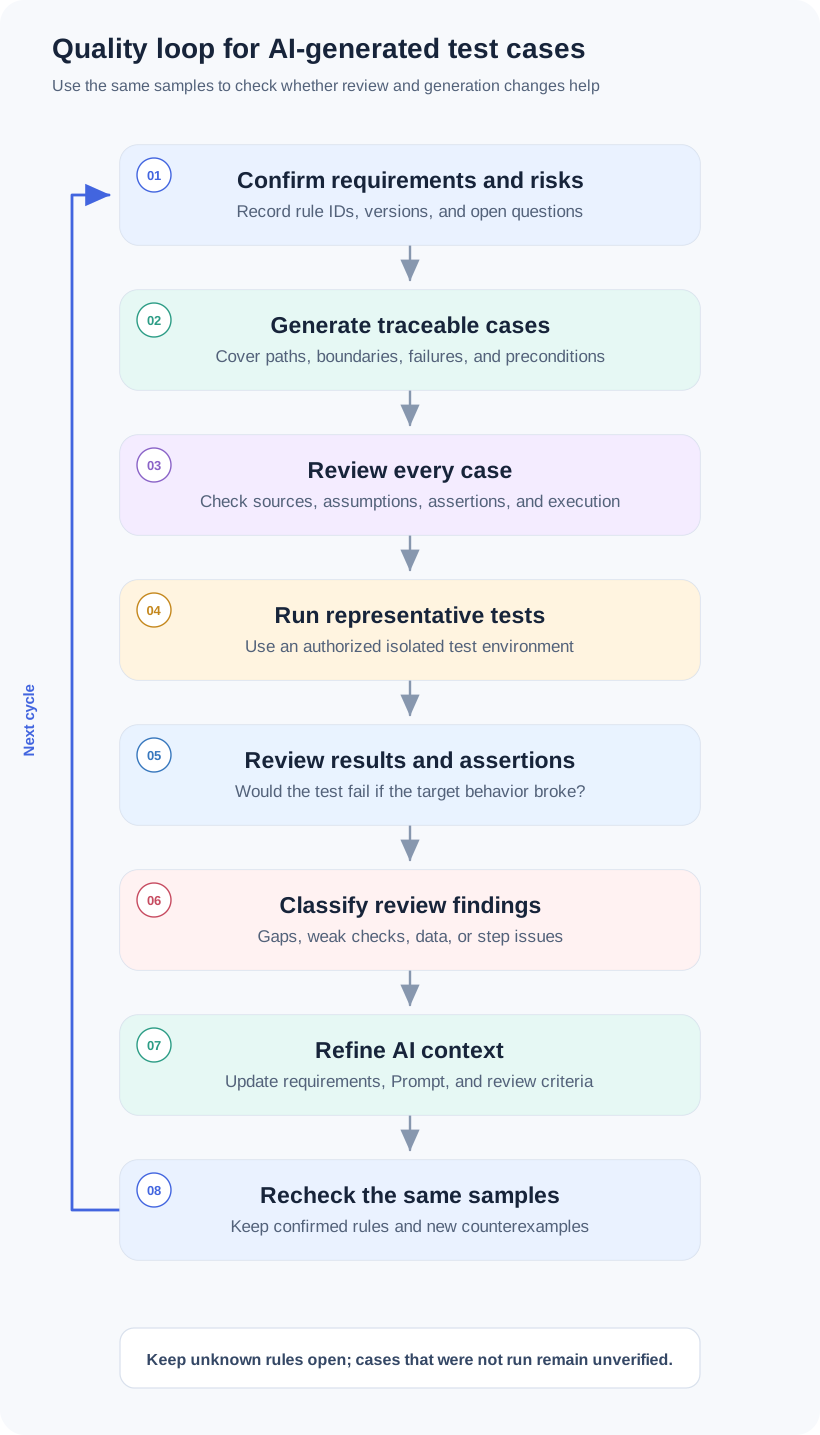
For each new requirement in daily testing, keep a representative sample set. Add issues found in review or execution to an improvement record with their cause and evidence. After changing generation context or review criteria, run the same samples again to check whether old issues disappeared and new ones appeared. Only confirmed business decisions become reusable rules; open questions remain open. Run the samples again when requirements, models, or Agent tools change.
That feedback from real review and execution helps AI-generated tests improve over time. Quality comes from traceable feedback and repeated checks, not the volume of a single output.