A decade ago, software testers often debated whether to learn test automation, which tools to master, and which certifications to pursue. In 2026, the questions have shifted to AI, how to use AI agents, whether to learn prompt engineering, and whether AI will replace testing roles.
Technology and tools change, as do job titles. Roles now include Software Tester, Quality Engineer, SDET (Software Development Engineer in Test), Quality Coach, and AI Native Quality Engineer. The boundaries around quality work continue to expand.
Tools and job titles have changed. Have the qualities that help a tester succeed changed as much?
Rosie Sherry, founder of the Ministry of Testing, first wrote about succeeding as a software tester in 2016 and updated the article in November 2026. She revisits how the work has changed and discusses quality engineering, AI, and continuous learning. This article uses her piece as a starting point and adds practical QA perspectives. Its learning plan, evaluation tables, time-savings example, and capability model are editorial extensions, not formal frameworks from Sherry.
There is no secret formula or universal career path. Being a good tester does not guarantee success as each person defines it, and someone who succeeds is not automatically a good tester. Success itself is personal. Finding a direction that fits, continuing to build capability, and creating meaningful value for your team are more practical foundations for growth.
Accept yourself: good testers come in different forms
Testers can feel uncertain at different stages of their careers:
- “I don’t have enough education or certifications, or I worry that I started too late.”
- “I’ve worked for years, but my automation skills still aren’t strong enough.”
- “I can’t build a test platform. Am I falling behind technically?”
- “Will a lack of certifications limit my career?”
- “Other people are already building multi-agent systems while I’m still learning prompts.”
- “AI is getting better at testing. Where does that leave my value?”
These concerns do not mean you are unsuited to testing. The work draws on different ways of thinking. Some people are good at exploring unknown risks; others understand complex business rules, dig into technical architecture, or help teams coordinate and improve quality.
Ady Stokes, a member of the Ministry of Testing community, has collected twelve testing mindsets in the Testing Mindset glossary entry (as of April 2026). The table selects six and gives examples of how they may show up in QA work:
| Mindset | Focus | Example in QA work |
|---|---|---|
| Exploratory | Finding unknown problems | Exploring boundaries and failure paths in a complex business flow |
| Sceptical | Checking whether assumptions hold | Reviewing AI-generated tests and conclusions |
| Analytical | Breaking down complex problems | Requirements analysis and root-cause analysis |
| Systemic | Understanding the whole and its dependencies | Cross-system testing and quality strategy |
| Ethical | Considering effects on users and society | Examining privacy, fairness, and safety risks in AI features |
| Collaborative | Solving problems with others | Contributing to quality planning, knowledge sharing, and team enablement |
The six examples are illustrative, not a ranking. Good testers do not need to excel in every dimension. Understanding your strengths, gaps, and interests helps you build a professional mix that suits you. Even experienced people doubt their abilities. Testers are people, not machines or models that know everything. Asking questions and seeking support are normal parts of the work.
Filter industry noise and choose a direction that fits
In 2016, much of the industry noise was about tools and certifications. In 2026, it is more often about agents, prompts, and claims that testing is dead. New models, frameworks, Model Context Protocol (MCP) servers, skills, and automation tools arrive constantly. It is easy to feel behind after only a few days away from industry news.
Keep learning about technology without chasing every new release. Notice what genuinely interests you, then make something: a drawing, a test scenario, an idea, or a plan can turn that interest into action. A QA professional working on complex financial products may gain more from understanding transaction rules, data consistency, and risk controls than from trying every AI UI testing tool. A quality engineer focused on developer productivity may get more value from CI/CD, test infrastructure, agent workflows, and automated quality gates.
From T-shaped skills to a comb-shaped profile
The traditional T-shaped model combines broad foundational knowledge with depth in one specialty. Rosie Sherry also refers to the comb-shaped tester: someone with broad interests and depth in several areas. The horizontal line represents breadth and the vertical strokes represent depth. The image below redraws these ideas as a skill profile; it is not an assessment score or the original source image.
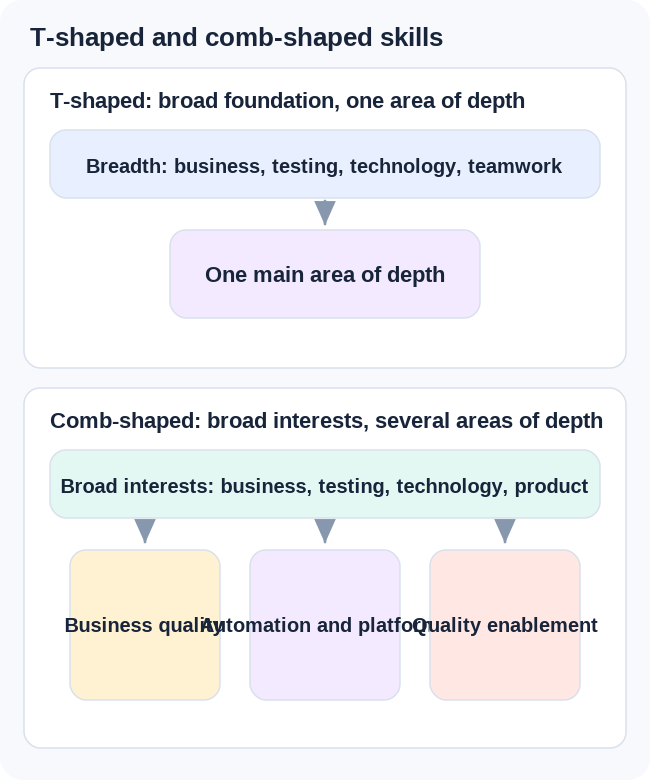
Figure: An original redrawing of the T-shaped and comb-shaped skill concepts.
Interests do not have to be directly about testing. Design, programming, psychology, accessibility, observability, data, security, business, education, and community work can all connect to quality. Testers can build several skill areas around their interests. The examples below are an editorial mapping:
| Interest | Possible areas of depth |
|---|---|
| Programming and tool development | Test automation, SDET work, test platforms |
| Product and business | Requirements quality, domain knowledge, business risk analysis |
| Psychology and user experience | Exploratory testing, usability testing |
| Data and analysis | Quality metrics, data quality |
| Infrastructure and operations | DevOps, continuous testing, observability |
| Security and privacy | Security testing, AI safety governance |
| Artificial intelligence | AI testing, agent quality engineering |
| Education and collaboration | Quality coaching, team enablement |
This connects with Sherry’s idea of bleeding job titles: quality roles overlap with adjacent work in product, development, operations, and data. Career growth does not have to mean becoming a generalist who knows everything. It can mean building related areas of depth on top of quality fundamentals.
The industry is still evolving, and testers can help shape it through their work. Genuine interest also helps people find useful connections between fields.
The useful question is whether you can combine these skills to solve practical problems, not how many technical terms you know.
Build capability through small, steady actions
Learning plans can grow into a long list: Python, Playwright, performance testing, security testing, large language model fundamentals, agent development, and a complete test platform. Months later, you may know a little about each area without having built a skill you can use reliably.
Instead of waiting to complete a large plan, keep doing specific, manageable work. The table below shows one possible pace for learning AI testing. It is a practical suggestion from this article, not a plan from Sherry’s original piece:
| Timing | Practice | Possible result |
|---|---|---|
| Week 1 | Use AI to analyze a real requirement | A requirements analysis record |
| Week 2 | Use AI to design test cases | Test cases and a human review |
| Week 3 | Try generating automated tests | Test code and execution evidence |
| Week 4 | Analyze errors in AI output | A summary of AI testing limitations |
| Month 2 | Standardize what worked | A prompt template or skill |
| Month 3 | Try it with the team and collect feedback | A practice example and improvement ideas |
Each learning effort does not need to produce a large project. It should help close a loop of learning, practice, feedback, and improvement. Results do not always need to be measured immediately; it can take years to see how a path has helped you. Ady Stokes has noted that continuous learning does not mean learning without a break; people cannot keep learning without rest. A steady pace is often easier to maintain than an intense burst followed by burnout.
Sherry describes this as investing in yourself. Small actions can snowball over time. Her savings analogy is that starting at 18 rather than 35 can make a major difference by retirement; the same idea applies to career growth. You do not need a grand plan to begin. Small investments might include:
- Going to a few meetups and one or two conferences each year.
- Writing a blog post or contributing a definition to a testing glossary.
- Learning through books, articles, videos, podcasts, and conversations.
- Trying pair testing or ensemble testing with your team.
- Using AI on real work, then sharing what helped and what did not.
- Watching how you use time and resources, and improving your work and the community around you.
- Helping others, sharing practices, reflecting, staying healthy, and learning to accept failure.
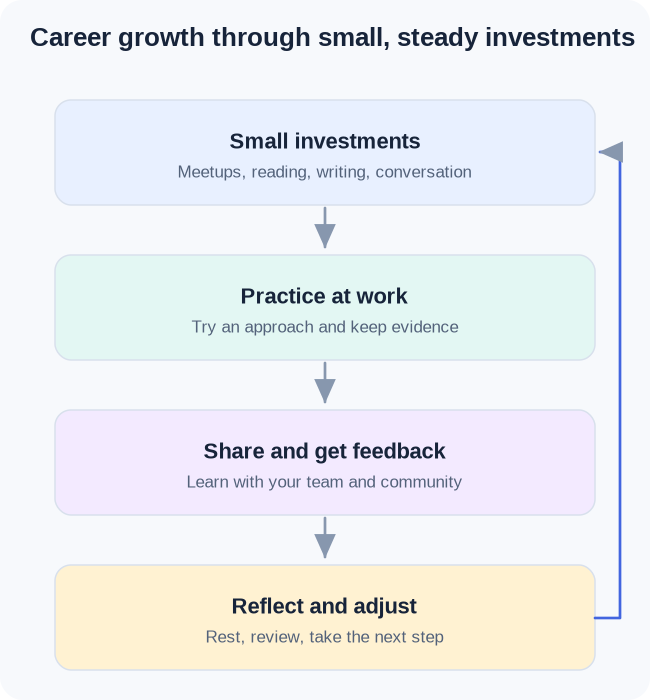
Figure: A practical loop for small, steady learning and practice.
Stay focused and avoid turning learning into information consumption
Email, Slack, meetings, notifications, online arguments, and a fresh AI announcement most mornings can all interrupt focus. Find an approach that works for you, and reward yourself after finishing a piece of work. Someone else’s method may not suit you.
Reading articles, bookmarking GitHub projects, and watching demos can build awareness, but knowing a tool and using it to solve a problem are different things. Knowing Playwright’s features does not mean you can diagnose a complex end-to-end (E2E) testing issue. Knowing that an agent can call tools does not mean you can design a reliable AI testing workflow.
Learning can happen at three levels:
| Level | Typical activity | Capability built |
|---|---|---|
| Information | Reading articles, watching videos and demos | Initial understanding |
| Practice | Writing code, designing tests, running tools | Applied skill |
| Knowledge building | Summarizing experience, explaining problems, creating reusable methods | Transferable expertise |
If you stay at the information level, learning can feel familiar without changing how you work. Instead of studying ten new tools at once, pick one related to a current need. Test its capabilities, cost, risks, and scope before deciding whether to invest further.
Evaluate quality value, not just output
Test case counts, defect counts, automation coverage, and test executions are useful process measures. On their own, however, they do not show whether quality work has been effective. Sherry’s advice to judge your own work is not a call to invent another metric; it is a prompt to look honestly at your work and its effects.
This is a hypothetical example, not project data:
| Dimension | QA A | QA B |
|---|---|---|
| Test cases written | 200 | 60 |
| Defects found | 30 | 8 |
| Involvement in requirements | Limited | Deep involvement |
| Design risks identified | Few | Several risks found early |
| Defect prevention | No specific focus | Helped improve rules and design |
| Team quality capability | Mostly executed work independently | Helped the team improve together |
By test and defect counts alone, QA A appears to have done more. The conclusion may change when you consider risk prevention, rework, and the team’s long-term capability.
AI can generate many test cases, scripts, and reports quickly. More output does not automatically improve assurance. Better questions are whether testing covered important risks, whether the conclusions have credible evidence, and whether the team can make better quality decisions as a result.
| Work output | Quality value |
|---|---|
| Number of test cases | Important risks are controlled |
| Number of defects | User impact and rework are reduced |
| Number of automation scripts | Regression capability improves for important business flows |
| Number of test runs | Release decisions have credible evidence |
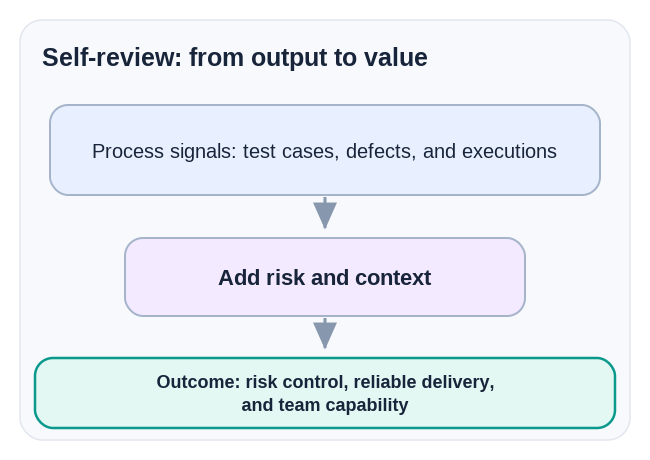
Figure: Assess practical quality value by combining process signals with risk and context.
Output still matters, but it should be considered alongside risk control, rework, decision quality, and team capability. During self-review, ask:
- Am I proud of my work, and what difference does it make to the team?
- Do I ask questions, seek feedback, and look for better ways to solve problems?
- Am I proactive, keeping up with good practice, and continuing to grow?
- Do I check and question AI output instead of accepting it on trust?
- What new skills am I learning, and what should I learn next?
Then ask the more direct question: If I were hiring, would I hire myself as I am today?
Create value and help your team see it
Consider what would happen to your team’s quality work if you stopped contributing to the current project one day. The question can help you see what you contribute and remind the team to make effective practices part of its shared knowledge.
The Whole Team Approach to Quality treats quality as a shared responsibility rather than a task for QA alone. QA professionals can help product teams improve acceptance criteria, help developers shape test strategies, identify systemic risks, and establish sustainable quality practices.
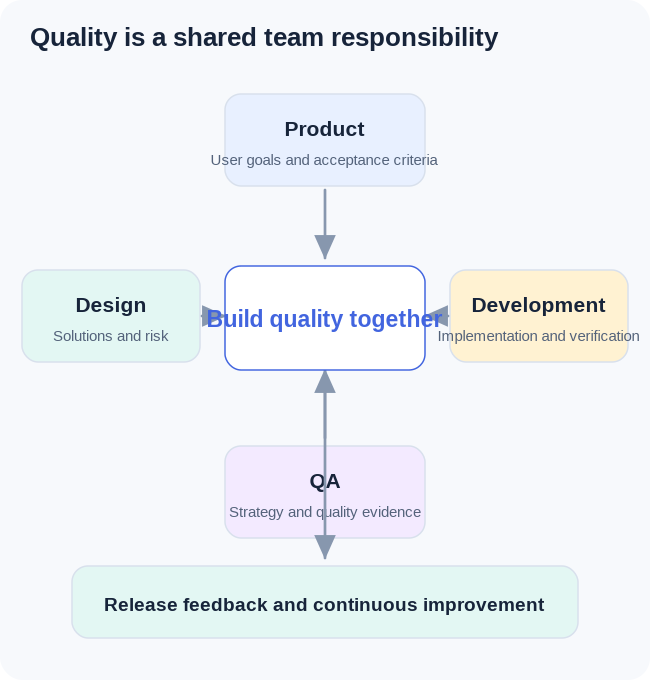
Figure: How the whole team contributes to quality.
You can also ask whether your work is high quality and efficient, whether you bring new ideas, whether you help the whole team think about quality, and whether the team understands the impact of your work.
When reporting, describe how quality work affects the business and the team, alongside the amount of work:
| Work | A more useful way to report it |
|---|---|
| Requirements review | Which conflicting business rules were found early? |
| Test automation | Which important business flows gained better regression coverage? |
| AI testing practice | Which work was saved, and which risks were introduced? |
| Defect analysis | Which recurring systemic problems were identified? |
| Process improvement | Which waits, rework, or repeated tasks were reduced? |
| Quality reporting | What evidence supported a release decision? |
Sharing outcomes helps the team understand the relationship between quality work and business results. Talk about your work in meetings and casual conversations, share relevant data, and write down your ideas and activities. Testers can contribute through different roles: some go deep on technology, some specialize in business quality, some build platforms, and others improve collaboration or quality governance.
Reduce waste by including quality throughout the lifecycle
Waste in quality work can be hidden in everyday processes: an ambiguous requirement is discovered only during testing; repetitive automation misses important risks; or an AI-generated script takes hours to correct after only minutes to generate. Organizations need to decide whether their investment is worthwhile, so people who find quicker, better, or more cost-effective ways to work can help make quality’s value visible.
When testing is concentrated at the end of development, problems are left for later. Continuous quality connects quality planning, verification, release decisions, and production feedback:
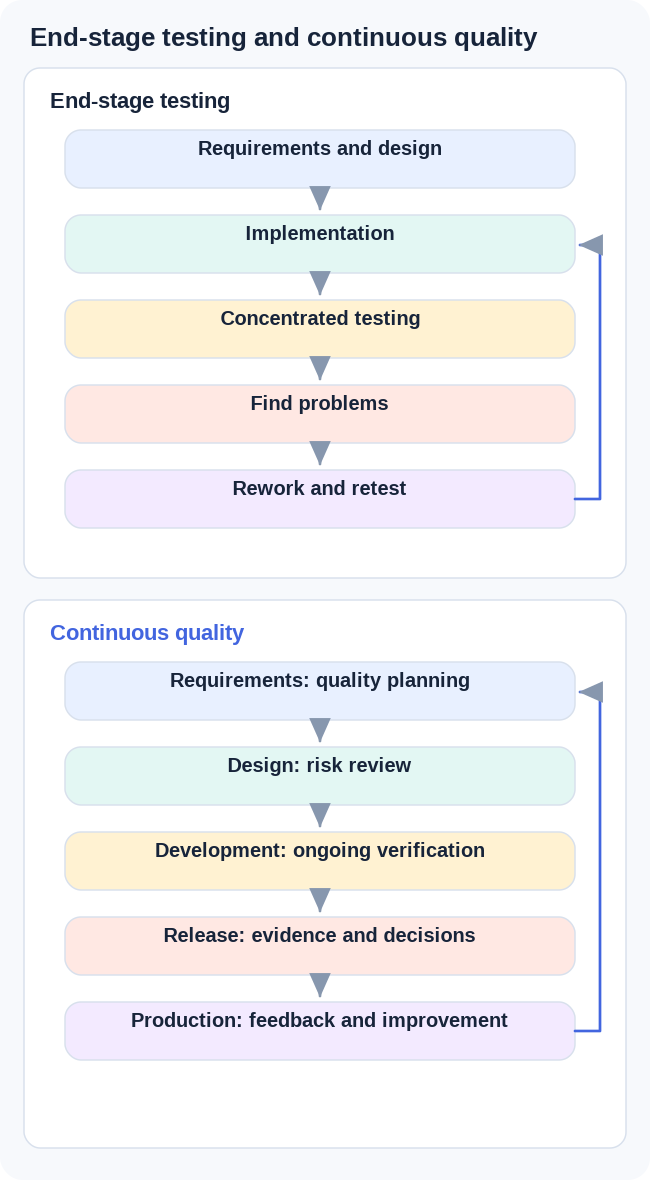
Figure: End-stage testing compared with continuous quality, redrawn from the stages in the notes.
| Stage | End-stage testing | Continuous quality |
|---|---|---|
| Requirements and planning | QA joins late | Discuss user goals, acceptance criteria, and risks early |
| Design | Problems surface after design is complete | Review risks during design |
| Development | Wait for the implementation before validating | Validate continuously during development |
| Release | Make a decision after concentrated testing | Use risk and evidence to guide the release |
| Production | React after a problem occurs | Feed user feedback into the next quality plan |
Continuous quality does not mean moving every test earlier. It means measuring, monitoring, and improving quality throughout the lifecycle, using appropriate practices at each stage. A problem found during a requirements discussion usually costs less to fix than one found in production. Each team still needs an approach that fits its risks and delivery model.
Evaluate AI’s total cost, not just generation speed
The figures below are an illustrative scenario in minutes, not measured results:
| Work | Traditional writing | AI-assisted writing |
|---|---|---|
| Writing or generation | 90 | 10 |
| Review and modification | 20 | 35 |
| Execution and verification | 10 | 15 |
| Total | 120 | 60 |
Looking only at writing or generation time, the work falls from 90 minutes to 10, a reduction of about 88.9%. For the full workflow, the time falls from 120 minutes to 60, a 50% reduction.
AI improves efficiency in this example, but generation speed is different from end-to-end delivery efficiency. Maintenance cost, incorrect assertions, test stability, and requirement coverage still need to be considered. Teams should validate the actual benefit with their own data. Testers need to learn how to use AI and how to evaluate its effects on the work.
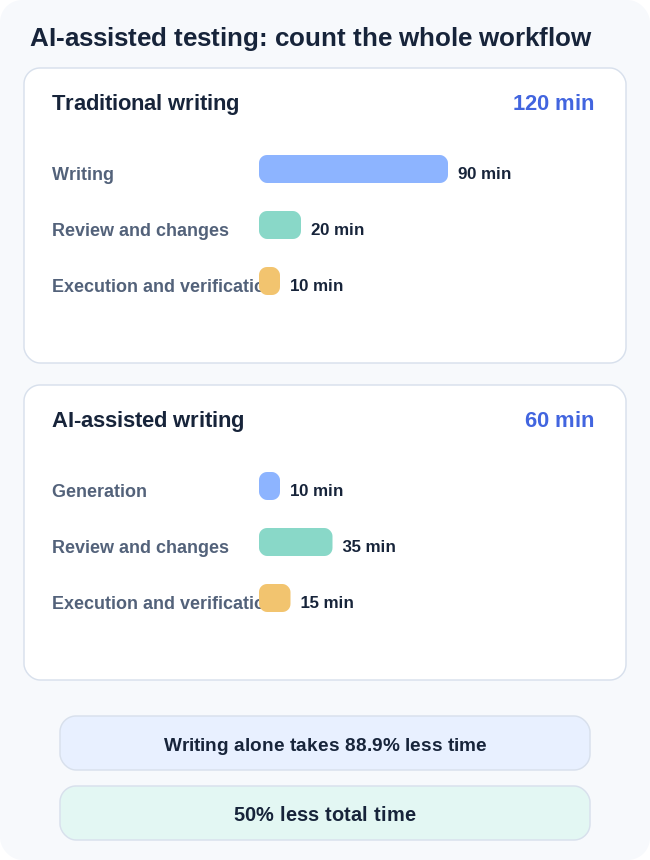
Figure: A redrawing of the hypothetical time estimates in the notes. The 88.9% reduction applies only to writing; the 50% reduction applies to the full workflow. Neither is measured data.
Some practical ways to reduce waste are to keep looking for improvements, honestly assess whether new tools including AI save time, research how others solve similar problems, and teach and share useful practices with your team and the testing community.
Keep understanding technology and expand from testing into quality engineering
Quality Engineering extends quality work into product development and still includes verification of finished software. It broadens where testing professionals can contribute beyond a change in job title.
| Dimension | Test execution focus | Quality engineering focus |
|---|---|---|
| Main goal | Find product defects | Prevent, detect, and control quality risks |
| Scope | Features and system behavior | Product, technology, process, and team |
| Timing | Mostly during verification | Across the development lifecycle |
| Outputs | Test cases, defects, and reports | Quality strategy, engineering capability, and evidence |
| Technology | Test tools and automation | Automation, CI/CD, observability, and AI |
| Team relationship | Execution and feedback | Collaboration, enablement, and continuous improvement |
Quality engineering builds on strong software testing skills and extends that work across more lifecycle stages and team activities. Jit Gosai notes that quality engineering is more than testing earlier in the software life cycle; Rahul Parwal adds that it is about building quality into things. The work can be highly technical or more business-focused. You can stay hands-on, lead, coach, or move into engineering management. Go deeper in relevant areas and explain what you can help solve. Do not claim to be good at everything if you cannot deliver on that promise.
Develop systems thinking
Systems thinking means looking beyond a single feature to understand its dependencies, affected users, and business goals. For an e-commerce payment flow, checking only that the payment API returns success can miss duplicate payments, out-of-sync order states, unreleased inventory, accounting errors, or failed refunds.
These risks cross payment, order, inventory, accounting, and after-sales workflows. Testers need to understand the chain and its state transitions, then design evidence for the relevant risks instead of checking only an individual API response.
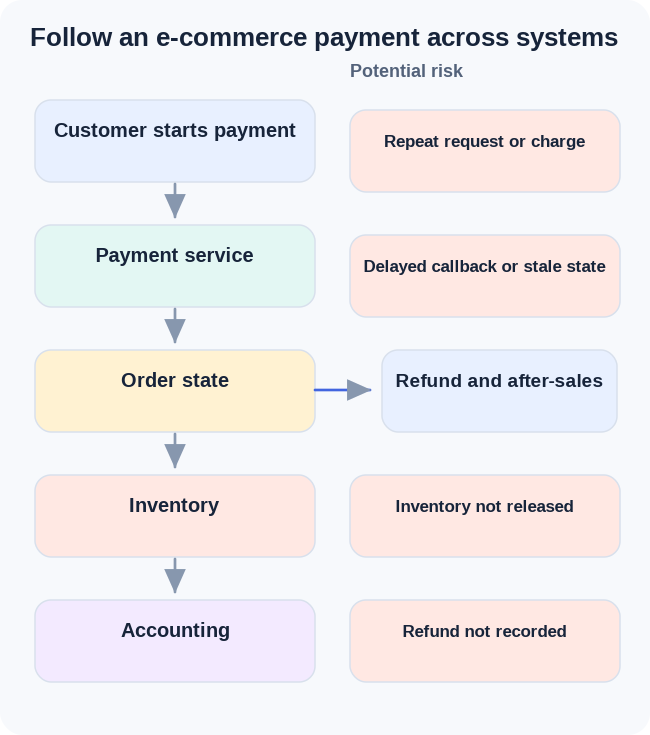
Figure: A simplified payment chain and its cross-system risks.
Build professional capability for AI-era quality engineering
Drawing on Sherry’s career discussion, this article organizes capabilities for AI Native Quality Engineering into five layers. This is an extension proposed here, not a formal model in Sherry’s article:
| Capability layer | Core skills |
|---|---|
| Software testing fundamentals | Test design, exploratory testing, defect analysis |
| Business understanding and risk analysis | Requirements analysis, domain knowledge, risk identification |
| Quality engineering and automation | APIs, E2E, CI/CD, test infrastructure |
| AI collaboration and verification | Prompt design, skills, agents, review of AI output |
| Quality strategy and governance | Quality gates, evidence management, risk decisions, continuous improvement |
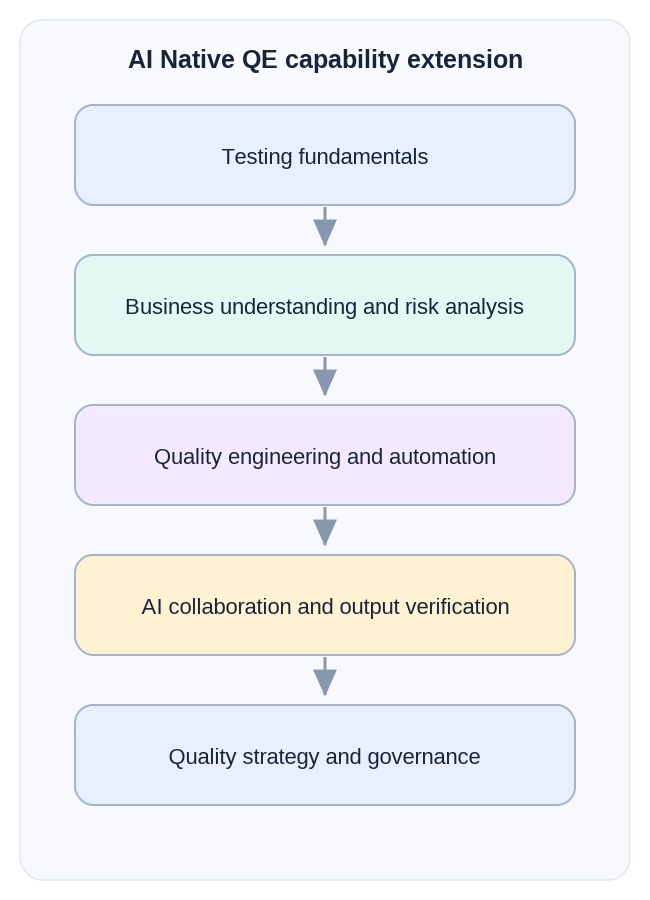
Figure: Capability layers for AI Native QE. This is an extension proposed in this article, not a formal framework from Sherry’s original article.
AI capability builds on testing and business expertise. Without test design knowledge, it is hard to judge whether AI-generated cases are complete. Without business knowledge, incorrect assertions can go unnoticed. Without a grasp of risk, a team cannot decide which tasks an agent may handle autonomously.
Long-term value comes from understanding problems, designing ways to verify them, organizing quality work, and making sound judgments about the results.
Make decisions before you feel fully ready
Career growth can stall when decisions are postponed. A good decision made in time can be better than a perfect one made too late: Should you move from functional testing to quality engineering? Learn AI agents? Try test development? Introduce a new quality practice to your team?
For low-risk choices that are easy to reverse, small experiments can reduce uncertainty. If you are unsure whether AI fits your team’s testing work, try it on a low-risk requirement. Record the time spent before and after, output quality, review effort, and testing results. Expand the use when the results are useful; adjust the approach or stop when they are not.
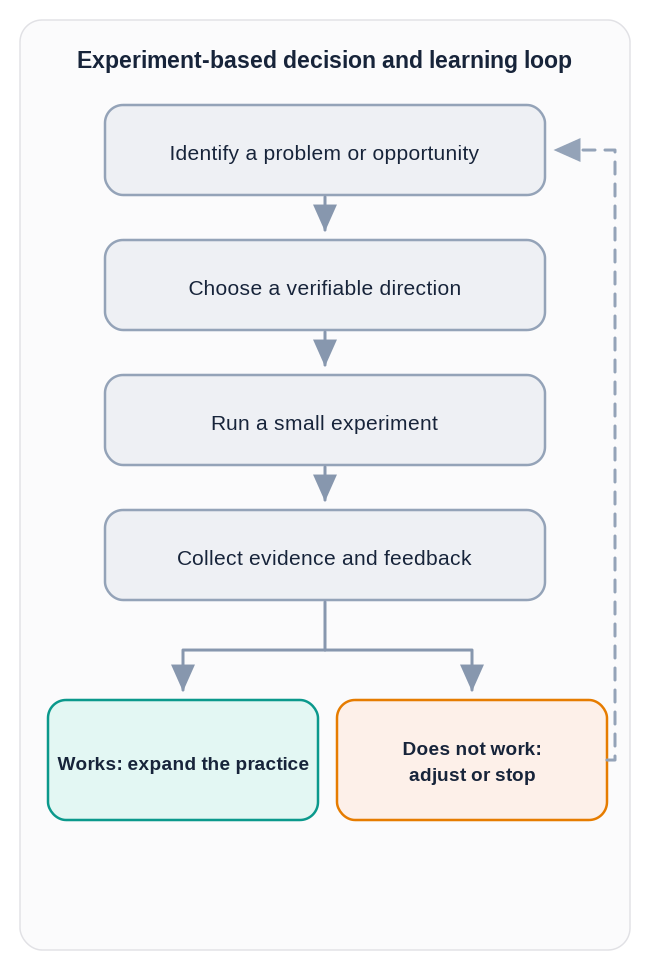
Figure: Test low-risk, reversible decisions on a small scale, then expand, adjust, or stop based on evidence.
Use stricter verification and approval for choices that affect production safety, user privacy, or release decisions. That still leaves room to act promptly on work that can be tested safely.
What to focus on at different career stages
The stages below are suggestions, not fixed promotion criteria:
| Career stage | Main focus | Development in the AI era |
|---|---|---|
| Junior tester | Testing fundamentals and business understanding | Use AI to support learning while thinking independently |
| Mid-level tester | Independent delivery and test design | Build a reusable AI testing workflow |
| Senior tester | Complex risks and quality strategy | Design and verify AI-assisted quality practices |
| Staff / Lead QE | System-wide quality capability | Improve quality engineering and AI governance |
| Quality Architect | Cross-system quality design | Build quality architecture, evidence chains, and quality gates |
| Quality Coach | Team enablement | Help teams collaborate with AI reliably |
| Engineering Manager | Organization and delivery | Balance engineering speed, quality risk, and business value |
Career growth does not have to lead to management. Technical depth, business quality, test platforms, team enablement, and AI quality governance can all become long-term directions. Choose an area you are willing to keep developing and where you can make a practical difference.
Frequently asked questions
Do testers have to learn programming in the AI era?
You do not have to become a professional developer, but you should understand the technology relevant to your work. Test automation, infrastructure, and agent development often call for stronger programming skills. Business quality, quality coaching, and governance may rely more on domain analysis, risk management, and collaboration.
Will AI reduce the value of software testers?
AI may lower the cost of some repetitive work and change the responsibilities and skills required in some roles. Test design, business judgment, complex risk analysis, and quality governance do not disappear just because test artifacts can be generated. The more useful question is how to use new technology to create quality value.
Does learning more technologies always make you more competitive?
No. Breadth helps you understand adjacent areas, but professional strength also needs depth and the ability to solve real problems. Designing, implementing, verifying, and improving a complete solution for a complex problem often demonstrates more capability than knowing the basics of many tools.
How can you tell whether your AI testing skills are improving?
Look for a shift from asking AI to generate content toward providing structured context, evaluating output, building a repeatable workflow, and using evidence to assess benefits and risks. Being able to review and verify AI’s work matters more than collecting more tools.
Final thoughts
From 2016 to 2026, software testing has moved through agile testing, automation, DevOps, continuous testing, quality engineering, and AI-assisted development. Understanding the business, staying curious, questioning assumptions, identifying risk, learning, collaborating, and taking responsibility for quality outcomes remain important foundations.
Learn about AI without chasing every tool. Understand technology without needing to master every field. Improve efficiency while keeping quality evidence trustworthy. Help the team see your work, and keep creating real value.
From Software Tester to Quality Engineer and AI Native Quality Engineer, the important change is the ability to solve quality problems, not the job title alone. AI can help us finish some work faster. Professional skill helps us choose the right work and judge whether its results matter.
References
- Rosie Sherry, “Ideas On How To Succeed As A Software Tester” (first published in 2016; updated in November 2026): https://www.ministryoftesting.com/insights/ideas-on-how-to-succeed-as-a-software-tester
- Ady Stokes, “Testing Mindset” (MoT Software Testing Glossary, updated April 2026): https://www.ministryoftesting.com/software-testing-glossary/testing-mindset
- Rosie Sherry, “Bleeding Job Titles: Our Roles Are Becoming More Specialised, Not Generalised”: https://www.ministryoftesting.com/moments/bleeding-job-titles-our-roles-are-becoming-more-specialised-not-generalised
- Ministry of Testing, “From Test Management to Quality Management Systems”: https://www.ministryoftesting.com/media-sessions/from-test-management-to-quality-management-systems
- Amna Zafar, “From Script Writer to Test Strategist”: https://www.ministryoftesting.com/moments/from-script-writer-to-test-strategist
More Resources
- Personal website: https://inaodeng.com/en/
- AI Test Auditor: https://github.com/AI-Native-QA-Lab/ai-test-auditor
- DeepSeek QA Workbench: https://github.com/naodeng/dsh-qa
- QA Skills: https://inaodeng.com/en/qaskills/
- Testing Wiki: https://inaodeng.com/en/wiki/
- AI Wiki: https://inaodeng.com/en/AIWiki/