
Test duration is one possible bottleneck. Shared environments, review queues, missing data, specialist handoffs, and capacity rules can also constrain flow.
Why this Skill is needed
The Testing Bottleneck Analysis Skill examines wait queues, dependencies, capacity, handoffs, and evidence for testing constraints. It converts a delay complaint into an evidence-bounded improvement path.
What the Skill does
The output should identify the next measurable constraint, not just the longest-looking queue.
Use this Skill to review why testing work waits, where flow stops, and what evidence can distinguish demand, capacity, dependency, or handoff constraints. It does not invent root causes or approve a process change.
A useful finding names the queue, dependency, capacity or handoff signal, time window, evidence state, priority, owner, close condition, and smallest validation.
Use it when test work is repeatedly waiting for environments, data, reviews, specialists, or CI capacity and the team needs a decision-ready diagnosis.
What it does not do
The Testing Bottleneck Analysis Skill can organize queue, dependency, capacity, and handoff evidence and propose the next check. It does not replace:
- Confirmation of rules, scope, and risk by the accountable domain owner.
- A real environment, account, dataset, log, or run record; static analysis does not become runtime evidence by itself.
- Authorization for release, compliance, production actions, or residual-risk acceptance.
- A Human decision when supplied sources conflict.
What it checks
The goal is not simply to find the longest queue. Identify where work waits and whether the available events distinguish queue time, service time, dependency, or handoff delay. Start with a matrix based on the source Skill’s output contract:
| Focus | Question before analysis | Handoff output |
|---|---|---|
| Stage and constraint | Which queue, dependency, capacity, or handoff has a wait | Related event, source, and evidence state |
| Impact scope | Which releases, validation scope, or risks are affected | Affected work and priority rationale |
| Validation plan | Smallest change that distinguishes candidate causes | Comparison window, measures, and stop condition |
| Decision boundary | Which capacity or process choices need owner approval | Decision maker, authority, and residual risk |
| Output contract | Whether the result will feed a table, CSV, JSON, or ticket | Confirm schema, enums, required fields, and evidence sources |
If a row has only a conventional expectation and no source or validation method, keep it open instead of turning it into a pass.
Audit inputs before you start
Before analysis, assign one of six evidence states to each input and check completeness, credibility, recency, and comparability. Missing or conflicting timestamps limit causal claims; they do not establish a process failure.
| State | Meaning | How this Skill should handle it |
|---|---|---|
| known | Directly supported by the supplied material | Keep the source, version, and time with the judgment |
| missing | Needed for this pass but not supplied | Name the smallest evidence action and limit the conclusion |
| conflicting | Sources disagree | Show both sources and route the conflict to an owner |
| stale | Present but outside the relevant version or time window | Mark freshness; old evidence is not current proof |
| out_of_scope | Related but excluded from this pass | Keep the boundary explicit |
| assumptions | Temporarily adopted to continue analysis | State how and when the assumption will be checked |
Keep the input version, scope, environment, evidence locations, and accountable owner together. Without a run record, deliver analysis, design, or a validation plan—not an execution pass.
From problem to structured Finding
Connect the source, scope, evidence state, analysis, owner, action, close condition, and validation before writing the conclusion. The case below keeps this Skill’s identifier and domain context.
Keep the decision layers separate
Keep facts, evidence-backed inferences, recommendations, and Human decisions separate in the report:
| Layer | How to write it | Application here |
|---|---|---|
| Fact | What the supplied material directly shows | Cite the source, version, input, or run record for the focus |
| Evidence-backed Inference | What several facts support together | Show the inference chain and retain uncertainty |
| Recommendation | The smallest next action | Name the evidence, review, execution, or regression path |
| Human Decision | What an accountable person must decide | Leave scope, risk acceptance, resources, and release meaning to the owner |
A complete case
The source fixture below shows how to separate dependency wait, execution, and rework, then test a concurrency claim against comparable observations. Keep missing, conflicting, or assumed material visible.
Input
The source Skill includes a sanitized synthetic fixture. It is a worked example, not a real team’s flow data.
| Material | What to provide | What to do when it is missing |
|---|---|---|
| T1 timeline | Arrives at minute 0; waits for environment from 0–40; executes from 40–50; reworks from 50–60; completes at minute 60; runner is idle during the environment wait | Keep each phase and event boundary explicit |
| Matched daily tasks | Same-day tasks of the same complexity: at concurrency 2, 10 completed tasks/hour and WIP 4; at concurrency 4, 6 completed tasks/hour, WIP 8, and more DB lock waits | Compare only the supplied matched window and task mix |
| Claims to review | B1 identifies the largest phase; B2 says more concurrency always helps; B3 treats 40 minutes of waiting as proof of understaffing; B4 proposes DB contention for controlled confirmation | Separate supported decision, unsupported claim, and hypothesis |
| Decision boundary | Observation window, owner, intervention, and rollback signal | Human confirms the trade-off and authorization |
Use a request like this:
Use the testing-bottleneck-analysis Skill.

Task: Separate dependency wait, execution, and rework in the supplied fixture, then assess the concurrency claims.
Inputs: [T1 event timeline, completion throughput, WIP, DB lock-wait observations]
Scope: [same-day tasks of the same complexity and stated concurrency levels]
Success criteria: [claims stay within the fixture and an experiment has measurable stop signals]
Exclude: [a staffing conclusion based only on wait time]

Calculate each phase, distinguish WIP from throughput, and classify B1–B4. Give evidence state, priority or `NOT_SCORED`, owner role, close condition, and the smallest validation action.
Analysis
T1’s cycle is 60 minutes: 40 minutes waiting for the environment, 10 minutes executing, and 10 minutes in rework. The runner is idle during the dependency wait. The fixture therefore supports DEPENDENCY_WAIT as the largest phase; the 60-minute cycle is not 60 minutes of labor.
For the matched daily tasks, concurrency 2 completes 10 tasks per hour with WIP 4. Concurrency 4 completes 6 per hour with WIP 8 and more DB lock waits. This sample does not prove DB contention caused the throughput drop, but it does refute “more concurrency always helps.” A 40-minute wait also does not prove understaffing when the runner is idle waiting for an environment.
Finding
Source-fixture decisions
| Claim | Fixture decision |
|---|---|
| B1 identifies the environment wait as the largest phase | DEPENDENCY_WAIT; the phase breakdown is 40 minutes waiting, 10 executing, and 10 in rework |
| B2 says more concurrency always helps | UNSUPPORTED; the supplied higher-concurrency sample has lower throughput and higher WIP |
| B3 treats the 40-minute wait as proof of understaffing | UNSUPPORTED; the runner is idle while waiting for the environment |
| B4 proposes DB contention as an explanation | HYPOTHESIS; the lock-wait observation needs a controlled comparison |
Turn the hypotheses into comparable experiments
Choose the smallest controlled change that distinguishes the hypotheses. Keep existing test and release controls in place, change one condition at a time, and agree stop or rollback signals with the owner before the experiment. Record other changes that could affect the result.
| Hypothesis | Smallest validation | Observation and boundary |
|---|---|---|
| Environment dependency drives the wait | Compare similar tasks with a recorded environment-ready event and booking status | Measure environment wait and total cycle; keep task mix, complexity, and window comparable |
| Higher concurrency reduces flow | In an approved, controlled comparison, record completed tasks, WIP, and DB lock waits at each level | Define the rollback signal with the owner before changing concurrency; the fixture does not establish a universal threshold |
| Staffing is insufficient | Compare arrivals, completions, utilization, and idle reasons by stage | A wait alone is insufficient; an idle runner may be blocked on an environment or material |
| Event data is incomplete | Capture arrival, environment-ready, execution start/end, rework, completion, and blocked reason | Keep the cause unassessed until the timeline is reviewable; do not infer missing durations |
WIP counts unfinished items; throughput counts completed items within the same window. Measure cycle time and each stage separately, define timestamp meanings and timezone, and retain raw events, calculation rules, experiment conditions, stop signals, and unexplained differences. A diagnosis can propose a change; it cannot prove root cause, throughput gain, or release readiness before validation. Average wait alone does not establish a cause.
Example finding: make the environment wait measurable
| Field | Example record |
|---|---|
| Finding | TBA-01: T1 spends 40 minutes waiting for its environment, the largest phase in the fixture; this does not establish understaffing |
| Source and trigger | Sanitized fixture timeline; trigger is repeated environment wait or a capacity claim based only on elapsed time |
| Expected concern | Total cycle time may be mistaken for labor, or a dependency may be mislabeled as a staffing shortage |
| Evidence state | known for the fixture’s phase breakdown; it is not a live project measurement, and DB contention remains a hypothesis |
| Impact and priority | The wait delays completion; priority is NOT_SCORED without project impact and risk criteria |
| Owner and open decision | The environment owner confirms readiness and booking events; the flow owner confirms the comparable task window and any authorized experiment |
| Action and close condition | Preserve work-item IDs and stage timestamps; close when the limiting phase and the effect of an approved change can be recalculated |
| Validation | Compare matched tasks using arrival, environment-ready, execution, rework, and completion events; retain raw data and calculation rules |
| Stop condition | If event definitions or task comparability are missing, keep the cause unassessed. Do not change concurrency until rollback signals and authority are confirmed. |
The finding separates the observed dependency wait from hypotheses about staffing or database contention.
Decision
The accountable owner confirms the decision question and risk trade-off; the Skill does not make that choice.
Validation
Before closing the finding, run the stated validation and retain the raw artifact. Without an execution record, the status remains unverified.
How a Finding enters the next stage
Handoff output
| Output field | Why it exists | Example status |
|---|---|---|
| Constraint finding | Observed queue, dependency, capacity, or handoff issue | Source and evidence state |
| Impact | How delay affects validation or risk | Priority and scope |
| Experiment | Smallest change that distinguishes hypotheses | Expected observation |
| Decision boundary | What requires Human capacity or process choice | Owner and residual risk |
Every conclusion should point to a source, evidence state, and next action. If evidence is missing, use pending, blocked, unassessed, or NOT_SCORED instead of filling the gap with confidence.
Next-stage route
Route each gap to the owner who can provide evidence or authorize a process change:
| Gap | Next owner | Handoff goal |
|---|---|---|
| Arrival, start, or completion times are missing | CI, environment, or review-system owner | Define the events and how they link to a release |
| Queue and service time are mixed together | Flow owner and analyst | Calculate wait and processing time by stage and show uncovered intervals |
| Handoff timing is unclear | The owners of the affected stages | Add handoff start and end events; keep any approval requirement in place |
| More environment capacity or staff is proposed | Authorized engineering manager | Decide on capacity, scope, and review date from the evidence |
Later conclusions remain bounded by the evidence state; the diagnosis does not authorize a process or capacity change.
How to prepare better input
Provide a fixed release window, queue and service timestamps, blocked reasons, dependency map, capacity schedule, handoff ownership, and the decision the analysis supports. Missing timestamps remain unassessed.
Keep input versions, scope, observation window, event definitions, evidence locations, assumptions, and the Human decision boundary in the handoff, plus the smallest validation action.
Working with other Skills
- Test Runtime Optimization: https://inaodeng.com/en/qaskills/test-runtime-optimization/ — handles slow execution after flow constraints are known.
- Quality Productivity Metrics: https://inaodeng.com/en/qaskills/quality-productivity-metrics/ — separates flow metrics from quality claims.
- Test Scope Analysis: https://inaodeng.com/en/qaskills/test-scope-analysis/ — shows which scope is blocked or deferred.
Common traps
- Calling the longest queue the bottleneck without checking downstream wait or service time.
- Using utilization or complaints as proof of capacity saturation.
- Changing process before defining a small experiment and success evidence.
Best practices
- Fix the observation window, work IDs, task complexity, arrival and completion events before comparing flow.
- Separate queue or dependency wait, execution, rework, handoffs, and blockers. Total cycle time is not labor time.
- Measure WIP as unfinished work and throughput as completed work in the same window. Use stage times, arrivals, completions, and utilization together; averages alone do not establish a cause.
- Test one intervention at a time with matched before-and-after measures. Agree stop or rollback signals and retain the conditions, versions, sources, and results.
First use: trace one delayed work item
- Choose one stage and a fixed observation window.
- Collect work IDs, task complexity, arrival, ready, start, handoff, rework, and completion events, plus WIP and completed items.
- Ask the Skill to split wait from execution, classify missing evidence, and propose the smallest controlled check. Keep staffing and root-cause claims open until evidence supports them.
Put bottleneck analysis inside the quality loop
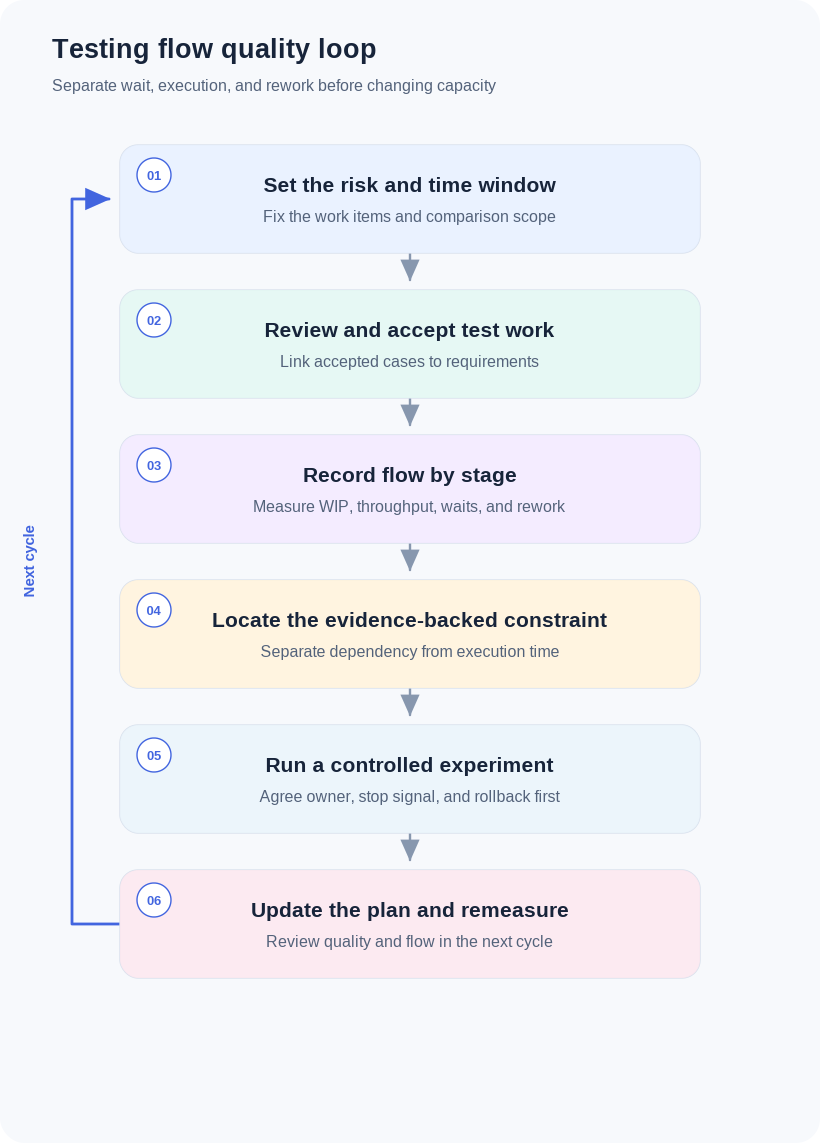
When AI generates test cases, the generated count alone does not show useful throughput. Review and deduplicate the cases, connect accepted work to requirements, then measure completion, waiting, rework, and quality outcomes. A change that increases WIP or contention can make delivery slower, so carry the result into the next test-planning cycle.
Install and invoke
npx skills add https://github.com/naodeng/awesome-qa-skills/tree/main/skills/en --skill testing-bottleneck-analysisUse the testing-bottleneck-analysis Skill.
Include objective, scope, versions, evidence paths, constraints, and decision boundary.
Audit inputs first, preserve evidence states, and finish with owner, close condition, and validation method.FAQ
Does this Skill automatically recommend more people?
No. It identifies evidence and trade-offs; capacity changes are a Human planning decision.
What if timestamps are incomplete?
Return a bounded diagnosis, mark causal findings unassessed, and request the smallest missing event timestamps.
Does increasing concurrency always increase throughput?
No. In the source fixture, the higher-concurrency sample has lower throughput, higher WIP, and more database lock waits. That observation challenges a universal claim; it does not prove which factor caused the change.
Should generated test cases count as completed work?
Not by their generated count alone. Review and deduplicate them, confirm acceptance, and measure completed work alongside waiting, rework, and quality evidence.
References
Source Skill and execution contract
The complete execution contract lives in the Testing Bottleneck Analysis prompt: https://github.com/naodeng/awesome-qa-skills/tree/main/skills/en/testing-types/testing-bottleneck-analysis/prompts/testing-bottleneck-analysis.md. The phase and concurrency calculations come from its sanitized synthetic fixture: https://github.com/naodeng/awesome-qa-skills/blob/main/skills/en/testing-types/testing-bottleneck-analysis/references/domain-decision-example.md.
The source Skill directory is available at: https://github.com/naodeng/awesome-qa-skills/tree/main/skills/en/testing-types/testing-bottleneck-analysis.
Further reading
- Testing Bottleneck Analysis details: https://inaodeng.com/en/qaskills/testing-bottleneck-analysis/
- Awesome QA Skills on GitHub: https://github.com/naodeng/awesome-qa-skills
More Resources
- Personal website: https://inaodeng.com/en/
- AI-generated test detection project: https://github.com/AI-Native-QA-Lab/ai-test-auditor
- DeepSeek QA Workbench: https://github.com/naodeng/dsh-qa
- More AI testing skills: https://inaodeng.com/en/qaskills/
- More testing wiki: https://inaodeng.com/en/wiki/
- More AI Wiki: https://inaodeng.com/en/AIWiki/