
Shorter Skill documentation is not automatically safer or clearer. Process Prose Trimming removes material that readers cannot resolve from the current repository while preserving the rules, measurements, and negative guarantees that still govern behavior.
Classify a passage before editing it
First confirm the file scope, language pair, and permission to edit. Then decide what each passage represents:
| Passage type | Treatment | Example |
|---|---|---|
| Current fact | Verify it and state it in the present tense | A supported command, path, or behavior |
| Contract or negative guarantee | Preserve its meaning and conditions | A refusal boundary or statement that an action is not performed |
| Historical record | Keep it in the appropriate archive when it is still needed | A dated release decision or incident record |
| Reasoning transcript or review dialogue | Remove process residue, or restate a durable fact if one remains | “The reviewer suggested this in PR 12” |
| Measurement or formal reference | Retain the value, scope, date, and source | A benchmark result or cited standard |
| Generated file, sealed archive, or fixture | Report it; do not edit without explicit authorization | A recorded Eval fixture used to reproduce a case |
Without this distinction, a reader-facing Skill can keep temporary review notes or lose history and safeguards that still matter.
Work in this order: list the authorized files and language pairs; classify each passage; find a current source for claims about commands, paths, or product behavior; then edit only material confirmed to be process residue. Report unverifiable facts as uncertain instead of rewriting them as capabilities to make the prose smoother.
Example: trim the sentence, preserve the evidence
The source Eval uses a synthetic contract containing a production-write prohibition, a sentence saying “This PR fixed the reviewer concern,” a measured limit of one local fixture with runtime effectiveness marked UNASSESSED, a dated issue reference, and a formal URL. In an authorized edit of contract.md, only the PR narration is process residue. Keep the prohibition, measurement and status, date, issue ID, and URL unchanged. The Eval also contains fixtures/recorded.json, whose recorded payload includes “This PR”; leave it untouched because fixture fidelity is part of the evidence.
Old-sounding text can still carry evidence or a safeguard. The target file, permission, and role of each sentence determine what may change.
A trim report should make the change auditable:
# Trimming report
## Deleted or restated
| Location | Type | Action | Reason |
## Preserved contracts and facts
## Unchanged scope
## Bilingual synchronization
Preserve what controls behavior
Before accepting a shorter version, compare the original and edited text for trigger conditions, required inputs, exceptions, refusal rules, failure handling, measurements, identifiers, and references. Keep an important negative guarantee even when it costs words. Do not collapse “not run” into “passed,” or change an assumption into a capability.
The source Skill does not set a target word count. It asks the maintainer to remove process residue and preserve durable content. After editing, read the complete affected page and its language pair; then verify that links, examples, and the unchanged scope still make sense. Do not edit generated files, sealed archives, fixtures, or related files outside the authorized scope.
Before delivery, compare the trigger and required inputs, limits and exceptions, failure paths, commands, versions, IDs, numbers, and references. Check that both languages still describe the same behavior. If deleting a sentence changes what a downstream user can rely on, treat it as a contract change and send it through prose review and change verification instead of treating it as a word-count edit.
A visible quality loop for AI-assisted documentation
Use this as a team workflow when AI drafts or revises a Skill, Prompt, or testing guide. The source Skill does not define this loop; the team applies its trimming steps during routine QA.
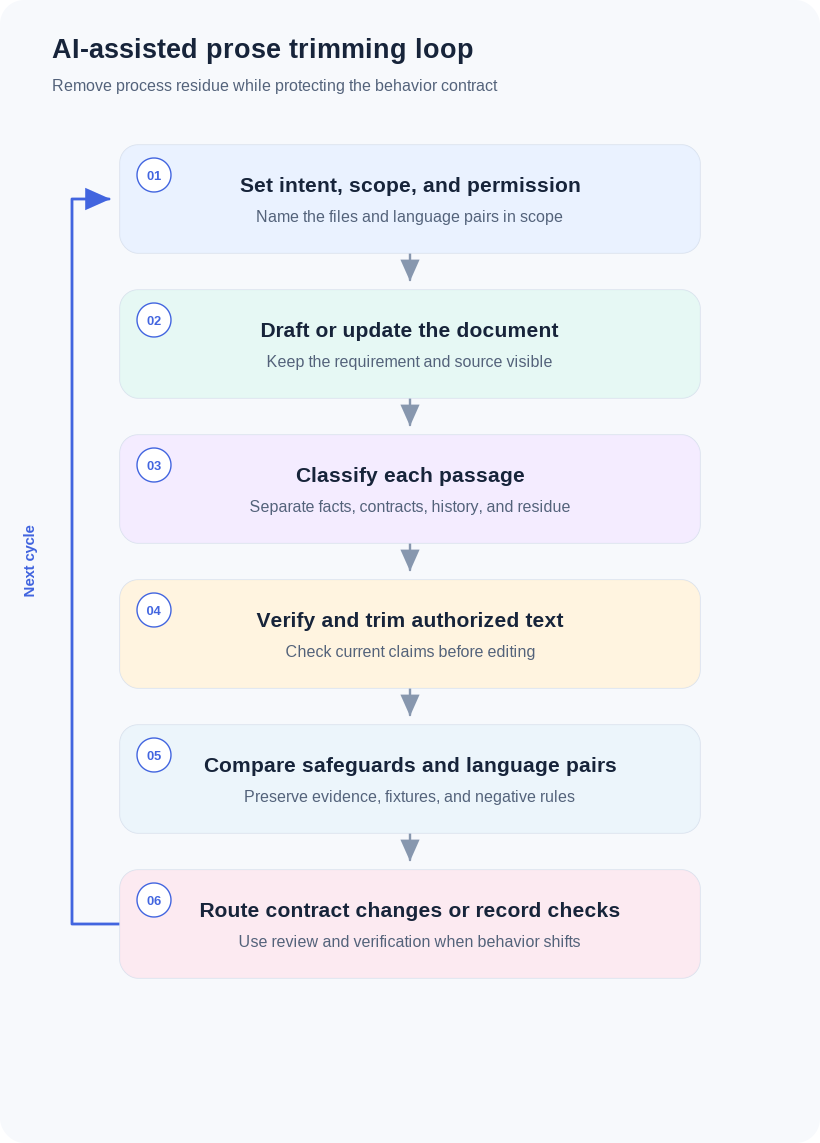
In daily QA work, apply it when an AI-generated test prompt or test guide is revised after a missed case. Preserve the requirement, expected result, and safety limits; remove only confirmed process residue; then check the generated tests against the requirement and run an authorized representative case. Feed a verified gap back into the next requirement or prompt revision. A prose trim alone does not establish that generated tests are correct.
Use the adjacent Skills for separate jobs
Skill Prose Contract Review: https://inaodeng.com/en/qaskills/skill-prose-review/ identifies ambiguity and contract gaps before an edit. Process Prose Trimming removes only the authorized residue. Skill Change Verification: https://inaodeng.com/en/qaskills/skill-change-verification/ checks the effect of the actual diff and keeps unrun behavior checks visible.
Install this Skill with:
npx skills add https://github.com/naodeng/awesome-qa-skills/tree/main/skills/en/skill-engineering/skill-prose-trimAfter installation, list the authorized files, language pairs, and the reason each passage may be removed. For example:
Use skill-prose-trim for these authorized files: [file list].
Language pairs: [languages and paired files].
Goal: remove confirmed process residue while preserving behavior contracts and historical facts.
For each candidate passage, classify it, verify current claims against a source, and report the edit or reason to retain it. Preserve triggers, inputs, exceptions, refusal rules, failure handling, measurements, identifiers, and references. Do not edit generated files, sealed archives, or fixtures.
FAQ
Should the edit aim for a fixed word count?
No. The source Skill sets no target length. Remove only material that no longer helps the reader or controls behavior, while preserving the full contract.
Can generated files or fixtures be trimmed with the prose?
No. The source Skill treats them as protected evidence; report them and edit only the files explicitly in scope.
If a sentence is no longer referenced by the AI, can it be deleted?
Not on that basis alone. First determine whether it is a current fact, contract, measurement, historical record, or protected fixture content. Keep it when it still governs behavior or supports evidence.
Best practices
- Agree on the exact files, language pairs, and edit permission before changing anything.
- Check current behavior against the implementation or contract; label unresolved claims as uncertain.
- Preserve negative guarantees, measured limits, identifiers, dates, and formal references exactly.
- Keep recorded fixtures and generated files outside the edit unless explicit authorization covers them.
- Review the complete edited page and its language pair, then report both preserved content and checks that were not run.
First use: a safe, small trim
- Select one authorized document and its paired translation; record the version or commit being reviewed.
- Ask the Skill to classify candidate passages and show the source for any current-state claim.
- If editing is allowed, remove only confirmed process narration; otherwise request a proposed before/after edit.
- Compare every protected rule, measurement, ID, date, link, and fixture reference with the original.
- Read both language versions end to end and use the report format above to record scope and evidence.
References
- Skill entry: https://github.com/naodeng/awesome-qa-skills/blob/main/skills/en/skill-engineering/skill-prose-trim/SKILL.md
- Prompt: https://github.com/naodeng/awesome-qa-skills/blob/main/skills/en/skill-engineering/skill-prose-trim/prompts/skill-prose-trim.md
- Authorized-edit and review-only Eval cases: https://github.com/naodeng/awesome-qa-skills/tree/main/skills/en/skill-engineering/skill-prose-trim/evals/cases
- Skill guide on this site: https://inaodeng.com/en/qaskills/skill-prose-trim/
More Resources
- Personal website: https://inaodeng.com/en/
- AI-generated test detection project: https://github.com/AI-Native-QA-Lab/ai-test-auditor
- DeepSeek QA Workbench: https://github.com/naodeng/dsh-qa
- More AI testing skills: https://inaodeng.com/en/qaskills/
- More testing wiki: https://inaodeng.com/en/wiki/
- More AI Wiki: https://inaodeng.com/en/AIWiki/